Still


By sid sibo

The bear stands steady on four deep legs, ears alert against the empty horizon she’s watched for millennia. She knows many secrets of emptiness. She knows the ripe sustenance of overlapping human traditions here. Hoon’Naqvut, Kwiyagatu Nukavachi, Shash Jaa, Ansh An Lashokdiwe:  different songs rich with nourishment, filled with energies that have powered dancing feet over centuries.

“You mean like the Energizer Bunny?” My son Sean is Tobacco and Rabbit Clan, and sometimes hears my thoughts. Like me, he’s a terrible dancer. But his endurance is half-way legendary. He can keep going.

“Don’t you have some race you need to be at?” I drop my arms from a sunrise greeting and glare at him. “Some hundred-miler over a muddy mountain. Somewhere far away?”

“I love you too.” He’s upside down, voice muffled as he stretches his long gallina legs, open hands on chokeberry-colored rock. The back of his t-shirt sports a hand-stenciled Water is Life meme.

“Now what’re you raising money for?” My question half-hearted.

“Campaign against importing Estonian radioactive waste to store next to White Mesa. Last thing we need on top of our water system is more hot rock.”

“Huh.” Somedays my word-barn echoes empty. Which, like the space between here and the hazy horizon, is full of pulsing, invisible things.

“I’ll make new shirts tomorrow to resist the upcoming oil and gas sales. Want one?”

“Can’t you combine that campaign with the anti-alabaster, anti-uranium and anti-coal mines? Or the anti-ATV park that dude wants to start in the monument?”

“S’not the monument anymore. Or all this wouldn’t be happening.” He rises, arms over his head as if he remembers. But he’s just stretching. It takes lots of stretching to keep going.

I lower myself onto crystal-rough rock and listen to the wind. Not, of course, that the wind makes a sound, but it plays on the edges of rocks and tips of grasses. On the cartilage of my ear. Instruments, all of us.

Sean runs in place, arms pumping. The earth’s tight skin a resonant drum I hear with my ribcage.

I watch. “Well, are you going?”

His cheeks puff out, and air bursts from him in popping rhythm. “Why do you stay?”

“Pfft. Their shit don’t scare me. She’s still here.” I toss my head a little sideways, toward the bear, without looking at her directly. Eye contact can be unnerving, not to mention impolite.

I catch the flash of Sean’s teeth bursting white in his gotcha smile as he kicks it in gear and lopes away downhill.

The scent of pinyon rises in his wake. Sean’s passage leaves behind dust I can taste, and my feet ache. The sound of a circling jay falls around me. What dance have I ever offered? Stillness rises from granular rock, into my interlocking backbones. I feel the morning desert changing, plateau light bleeding as if at a fawn’s birth. Soundless dancers with dark blue skin shimmy across mesa space, stretching from unseen cloud toward unknowable earth.


Living on the west slope of the Rocky Mountains, sid sibo recently won the Neltje Blanchan Memorial Writing Award and an Honorable Mention in the Rick DeMarinis Short Story contest. Publications include Evocations, Orca, Cutthroat, Brilliant Flash Fiction and Artscapes. An environmental analysis job seeds a variety of creative work.


Lolo


By Jeremy Chu

Grandpa shifted his stare

from behind the wheel,

met his daydream where

Fraser River met shoreline

and fed it to me:


 you know what’s under there?


The word Crab came jagged through

the island consonants of his speech,

though words kept coming,


How their many rich bodies

must be splayed under the water’s

edge, How a single outboard engine

and a modest collection of traps

would bring haul to hand.


We held the idea like breath

as we passed the slough, entered

the tunnel that bayoneted

through the river

and bled into town,


the West

remaining rather unwon.


Jeremy Chu is a Filipino-Chinese poet, writing as a guest on the unceded territories of the Sḵwx̱wú7mesh (Squamish), Səl̓ílwətaʔ/Selilwitulh (Tsleil-Waututh) and xʷməθkʷəy̓əm (Musqueam) Nations. Chu's work has been featured in W49 and Pocket Lint Magazine. His writing wonders: Does love reveal itself differently, the further one crosses the Pacific?


Cave Art


By Todd Sformo

Only hundreds of feet into the earth, declining slightly in slope, is time at 45,000 before present, where a placard punched into the permafrost defines a formation called reticulate chaotic. The dark of the cave starves light except for bulbs that carve-out the near, although exact boundaries can’t be pinned. The cave, therefore, retains much of its netherworld quality that comes not from long, arduous exploration like that of the sea, the poles, the Amazon, but from excavation, into a world that was never meant to be, never an explorer’s geography or conquest, never a final destination.

Fog of silt, loess, rises like trapped butterflies on an airstream; once up can’t get down as a liquid breeze buoys the deposits in a drowning, milling fill, a floating quicksand that coats all surfaces and moist linings.  You see this when you blow your nose.  Ice-cemented walls and billowy lithic ceilings inspire the dolorous, the road edges of strewn.  Even the cool of the cave does not stave off odors of ruin, despite perennially frozen. There’s an un-orderly decay at 30 meters where roots, stems of grass (some still slight green), bones of the extinct, rust into this void at 14,000.  I reach for the ceiling, simultaneously touching the bottom of a dulled Martian-photo lake; a drop of melt on my finger loses itself into muddies.  And a few lunar steps away, an ice wedge, a liquid filled crack 25,000 years ago, is a buried waterfall, a statue within, from which bacteria that can come back have been caught in the solid mist of crystalline time, but I move easily.  Four seconds to cross meter 40 to 50, reeling off thousands of years, down to meter 70 at 45,000.

As if trying to fix distant stars, I stare up at the reticulate:  birds’ feet, hopping in mud.  Cuneiform.  Dehiscence in-filled with ice-thin black.  Sutures.  This void integrates with an astronomer’s gaze, but in meter-years, not infinity, into man-made circumference, unlined.  I am behind a mosaic, behind unfathomable tesserae.  My damp hand on the cold wall has soaked up powdery silt, and a stone peels loose.  Loess plummets, a smoky amount rises, air-flung in convolutions and kink, and I stamp on gravel my ancient thumbprint.


Todd Sformo is a biologist in Utqiaġvik (formerly Barrow), Alaska, working on fish and bowhead whales to support subsistence activities for the Inupiat communities of the North Slope. Besides scientific papers, he has prose poems in Hippocampus, Cirque, and The Ekphrastic Review, and essays in Catamaran and Interalia Magazine.


Mistranslations


By Emma Miao

after “靜夜思” by Li Bai


床前明月光

Moonlight falls before the bed


疑是地上霜

Like frost on the frozen ground.


举头望明月

Look up at the bright moon,


低头思故乡。

Look down, think of home.


1.


the moon falls / like ice. / the moon stands

on the bed / breaks / into so many other

moons. / & fingers. / the night, slashing open //

the day I left // the frost. /

& the whiplashed bones / of the

roadstruck deer


2.


the sky / is a bruise / swallowing

me whole / this house / means a

child, laughing in mama’s arms // means

what is the moon / if not my body //

& the deer / stared me in the mouth /

four years / skidding on the midnight

road / & the eyes / saying turn back /

carve up the bed                      & grieve


3.

Snow falls on the snowy moon. Look up, child.

Home is some unreachable thing.


Emma Miao is a poet from Vancouver, BC. Her poems are published in Atlanta Review, Permafrost Magazine, Frontier Poetry and Quarterly West. She is the winner of the 2021 Cincinnati Review Schiff Award for Poetry and The Fiddlehead's 2020 Ralph Gustafson Prize for Poetry. She hopes you have a wonderful day.


Barefeet on a Dirt Path or Where Little Girls Still Run in Their Barefeet


By Alonna J. Carter

I come from a place where little girls still run in the dirt in their bare feet,

A commonwealth, known for clear country skies and mountain peaks.

The Blue Ridge Mountain holds the secrets.

And to me she never speaks

Except to say, “Hello child you’ve come again.”

And to tell me that buried in her bosom are the bones of my kin.

Africans, Irishmen, Scotsman, Englishmen

And some East and West Indians, and Natives

Collided under Virginia skies

They mixed Brown, black, and white, and created something I’ve tried to identify.

At the Rappahannock river, they tried to wash their sins away.

And those who were landed ignored the that this fertile earth, rocked the “cradle of slaves.”

One night in a dream, my mulatto Nana Annie’s grave called to me,

And told me I could pay homage to her where she was buried amongst the weeds.

Her father was the biggest cattle farmer in land.

But his daughter’s name was traced in cement on her tombstone, by her son’s hand.

And Grandpa Lewis bought land and signed his own name on deed,

Seven years after he was freed.

Regency, Revolution, and Rebellion run like the river through my veins,

And when my feet touch the soil, my history I reclaim,

And turn my back to stone relics that were designed to make me afraid,

 and turn my head toward the future for which my ancestors have paved.

Within the clearing of the Shenandoah, journey and discovery meet and birth hope.

In a land where little girls still run in the dirt in their bare feet


Alonna J. Carter is a freelance writer and Public Historian, who specializes in African American genealogy and history. Her poem Shots Fired was featured in The Dreamers Anthology: Writing Inspired by the lives of Dr. Martin Luther King, Jr., and Anne Frank.


Ask the Highwaymen


By Lauren Johnson

What was Old Florida?

Spine-wreaking work

in sweltering citrus groves?

Or capturing

in self-taught strokes of oil

waves diamonded

by holy sunlight,

undying palm trees

laughing with greenness,

and mangrove-framed rivers

drenched in the borrowed royalty

of an orchid-purple sky?


Lauren Johnson is from Orlando, Florida. Her work has appeared in Living Waters Review and The Sailfish Review. When she is not writing, she enjoys reading retold myths, contemplating the meaning of the universe, and baking bread.


Autumn Offerings


By Lauren Woods

I told her I didn’t need her change, although she sensed enough to turn her unicorn bank upside down and shake it onto my bed. I sent her to play outside. So she sought and brought to me, with such devotion, a brittle stick. A flower chosen because I said I loved yellow. A chalky mushroom fresh from a morning storm, a blood red leaf with droplets still on top, a stew of leaves and grass crushed by rock, leaving smears of green on the wet sidewalk, impressions of past, fleeting lives. A quiet incantation, a nature brew. A secret get rich potion, made up of small parts, chosen because they, too, once sprung up like miracles. A brew of bountiful treasures, discarded by nature and resurrected by small hands. It worked.


Lauren Woods is a Washington, DC based writer, with work in The Forge, Hobart, Lost Balloon, The Offing, and other journals. She tweets @Ladiwoods1


Grace of Falling


By Xiaoly Li

pear flowers descent

     white stars embellish

         lush grass

     fresh  free   corollas

drawn to earth

     scattered in wind

          broken   restless   yet

     dive into the gravity of

this tenderness

     this decay

          limitless


Xiaoly Li’s poetry has recently appeared in Spillway, American Journal of Poetry, Atlanta Review, Chautauqua, Rhino, J Journal and elsewhere; and in several anthologies. She has been nominated for Best of the Net twice, Best New Poets, and a Pushcart Prize. Xiaoly received her Ph.D. in EE from WPI.


Huitlacoche


By Phoebe Myers

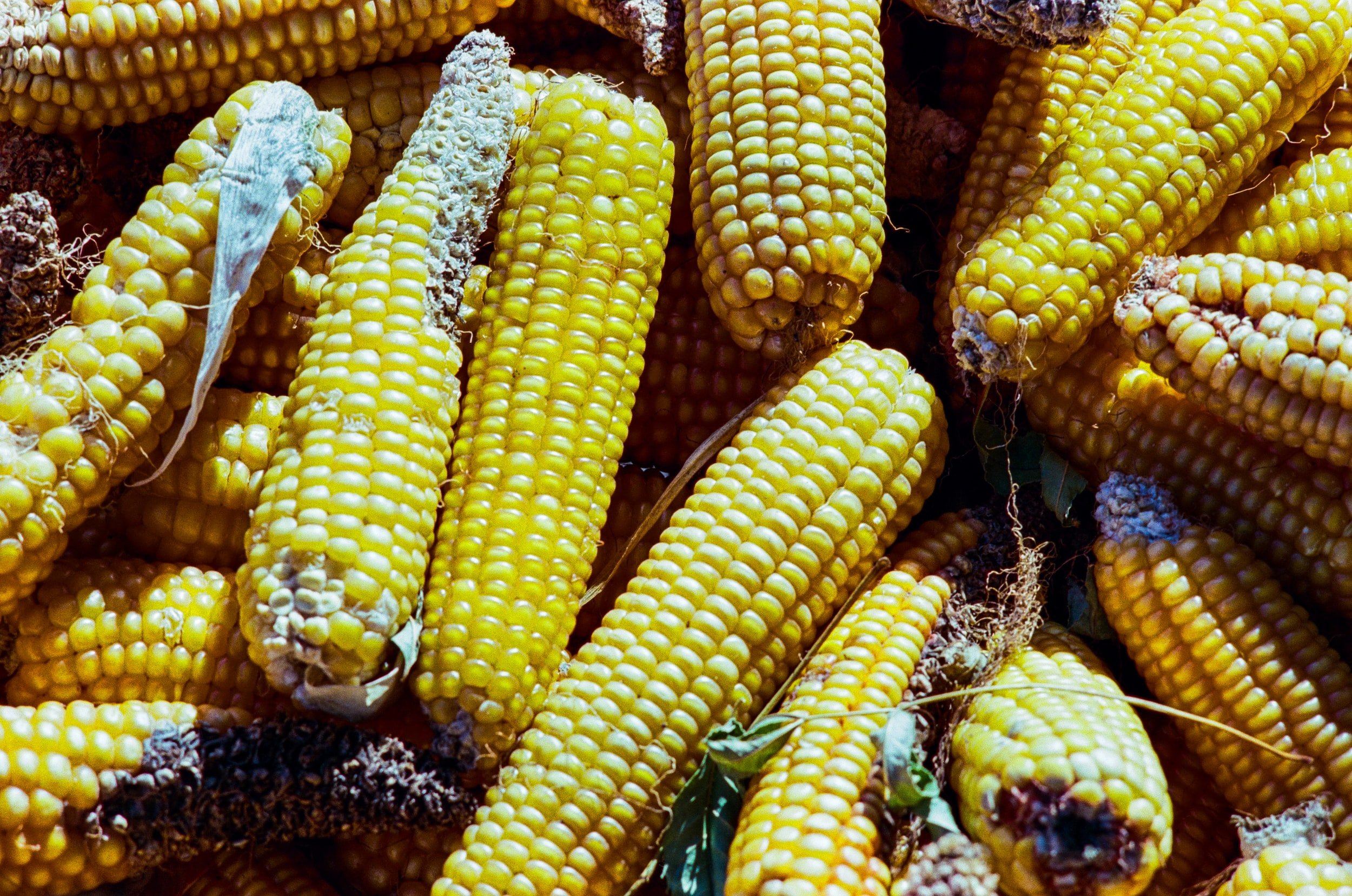
Peeled back, the corn here is jeweled

black. Its side froths into storm clouds


firm but spongy - ready to gather.

One darkened kernel renders the ear


unsellable, corn smut. Unsaleable devil’s

corn, the velvet truffle of the heartland


snuffed out by my tender, unseen nose.  

When combusted it weeps ink, rusts.


In all the books of opioids and the death

of industry this earthy resin is unwritten,


our fungus scourged.


Each evening, after combines winnow

rows of gold, reap and thresh


I watch a blackbird wait, wings in arabesque.

Rising moon serrates the wheaten


dome of lost day. Only when sky melts

into indigo and the fields butter with dew


will the blackbird escape its pastry entremets.

Our own selves, too, mushroom in night rains.


Phoebe Myers is a writer currently finishing her M.F.A in creative nonfiction from Florida State University. Her work has recently appeared in Tricycle: The Buddhist Review, Adelaide, and The Florida Review. She received two residencies at Art Farm Nebraska where she learned how to use a reciprocating saw.


8


By Brendan Connolly

i went swimming in a clutch of mangrove trees and came out with salt for hair

the trees did not want me to leave, their roots spacious and promising to make me carbon,

but my feet were deep in mud and i snatched for shore past brackish water to breathe

i laid on my back and labored constellations for my heroes from four visible stars, my

clothes drying on abandoned boat trailers softly assaulted by the surf

horseshoe crabs tugged at loose threads from my shirt that only spoke of amsterdam. it

was kelly green and attracted many compliments, but i didnt need it anymore

i had disproven evolution as farsighted hubris, writing my equation with the flame from a

plastic lighter, leaving my life/s work of glass at daybreak


Brendan Connolly writes stuff. He lives in New York City.


Wind-Talk/FIRst nations


BY ROWAN KILDUFF

“Just like other beings, artists need earth to stand on, water to drink, and air to breathe in… global survival is the primary issue for artists just as it is for all other human beings.”

                                                                                      — Kazuaki Tanahashi

“People protect what they love”

                                                         — Jacques-Yves Cousteau

KOWAL: Do you ever feel like you’re a hopeless idealist?

SNYDER: No. Never. (Laughs.) I’ve always considered myself very practical.

                                                                                              — Gary Snyder interview, The Real Work


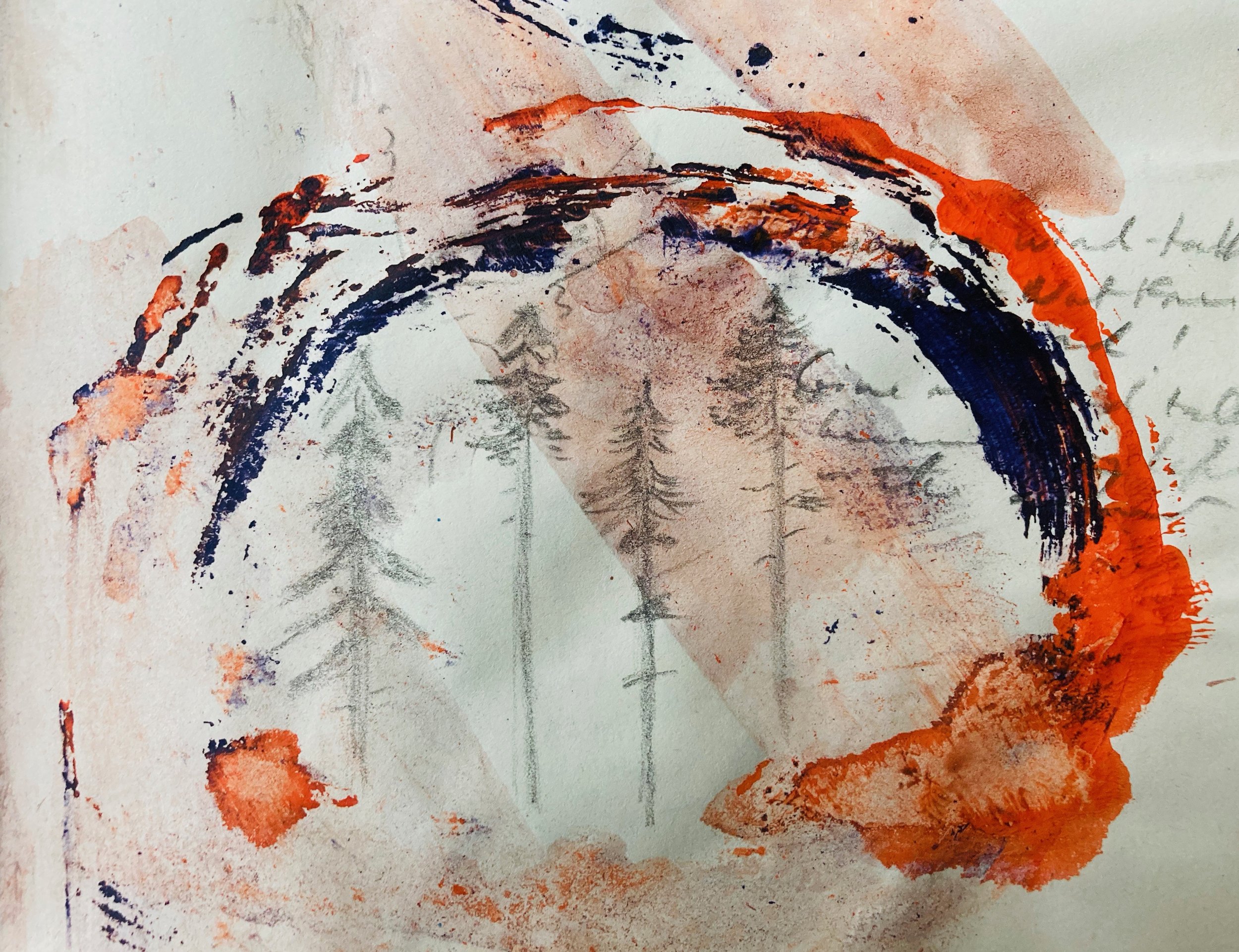
‘’WIND-TALK / FIRst nations’’ is out of my notebook. It’s really an illustration or accompaniment to the song / poem ‘’Give me wind-talk’’, (from Peace Songs) which has the basic point that we search and search the answer — for peace, for what it’s all about, etc. — but ‘every life is the answer.’ There is a bit of Buddhism in this in the idea of interconnection and interdependence; it has something from the First Nations / Native American new-old ways of listening to the wind, to the Planet’s voice, thinking of Earth Democracy, with the trees, the rocks, & the rivers all part of it. ‘’FIRst Nations’’ is from something I wrote about the old-growth clear-cuts in T’l’oqwxwat.


Future’s calling strong.

New songs will come,

and the machinery will one day

stop.


The colored arc is the sky, the sky shelter (interdependence again!) and is most definitely influenced by Japanese Brushmaster, Kazuaki Tanahashi’s colorful enso & one-stroke painting (of which I dreamt about, I was making it in blue, Kaz said I will maybe start to make my own circles); pencil is temporary, earthy for me — so the fir trees are pencilled. There are some lines leading out, through the arc, off the page — best make up your own minds about that.  Also these lines appear in pencil:


Give me Wind-talk,

the love is sky and sunrise.

Give me Wind-talk

when I am searching the answer.

Give me Wind-talk,

all life is celebrating!

Give me Wind-talk,

Free or Not Free is mind.

Give me Wind-talk

because every life is the answer.

Give me Wind-talk,

now the clouded world is gone.


Where to go from here?

We and our environment create each other. Life is in the relationships, in the meeting points. It takes place on every level, with no higher or lower. There can be no special value assigned to our lives. In this there is great freedom. With all this in mind, collective consciousness and inter-species or multi-dimensional communication and interaction does not have to sound so far out. In fact, continuing to turn this planet's resources into money, and supporting global piracy and the complete destruction of our actual brothers and sisters (all species) shows a much bigger abstraction, far from the real world. We might just be the youngest members of the family here on Planet Earth, but we might just learn to listen to what the wind is telling us. We can talk to each other, seeing through the eyes of the other, without seeing any other. Try to stay in the center, life says; the center-point from which all bursts outward; the empty center.

(I'm thinking here of the Heart Sutra.)


Rowan Kilduff is a mountain-runner and peace activist. His work supports A World Without Armies, Greenpeace and The Rewilding Institute. Now lives in the Czech Republic with his wife and son, and many good friends around. Find his writing here: Rewilding Earth (from The Rewilding Institute, US. Previously Wild Earth). Wingspan (from the Raptor Research Foundation, US). Dragonfly Library dragonfly.eco, Mi’kma’ki, CA. Irish Poetry Reading Archive, Special Collections, Leabharlann UCD, IRL.


Reflection


By Lucy Zhang


Lucy Zhang writes, codes and watches anime. Her work has appeared in New Orleans Review, Up the Staircase Quarterly, Chestnut Review, Black Warrior Review, and elsewhere, and was selected for Best Microfiction 2021 and Best Small Fictions 2021. Find her at https://kowaretasekai.wordpress.com/ or on Twitter @Dango_Ramen.


Snowbirds

 
unsplash-image-pAIF_eD1uX8.jpg

BY Jen Karetnick

Over the Australian pine, the Dutch pipe vine lattices.

Our backs ripen with humidity as we guide and prune it,

heads trickling the briny tint left by trapezius industry.


The vegetation doesn’t know that we, too, are invasive, winged

outflow of northeasterners making improvements

of a different nature. A colony of caterpillars has also


disturbed the leaves, the flowers that lick moisture from

air with their wide, floppy tongues. The word “carpetbaggers”

is no longer in vogue. But while we can pretend to be


almost symbiotic, we are parasites, laying eggs. The truth is

visual and fleeting, our flight painted by our ingested hosts.


Jen Karetnick's fourth full-length book is The Burning Where Breath Used to Be (David Robert Books, September 2020), an Eric Hoffer Poetry Category Finalist and a Kops-Fetherling Honorable Mention. Co-founder/managing editor of SWWIM Every Day, she has work forthcoming in The Comstock Review, Matter, Terrain.org, and elsewhere. See jkaretnick.com.


All Saints' Day

 
unsplash-image-Ik4Df7hISDQ.jpg

BY BRUCE MEYER

Even after market on the last Saturday of October there were still too many pumpkins left over. Some had been rejected at the stall where the first waxed turnips and the last of the autumn apples had been snapped up leaving an empty space where they had been displayed. Some were misshapen through no fault of their own, having grown next to a larger, more determined gourd that became a successful pumpkin, ridged, nicely and evenly orange without a touch of green on its girth, and swollen to a perfect jack-o-lantern shape with a sturdy green stem. The failures had been off-loaded from the flatbed while their forsaken siblings floated in the sea of mud as the first snow melted in a sweat upon their skin. The fields would have to be cleared before the heavy snow so a crop of alfalfa could take the place of the pumpkins once the soil thawed and April made the ground new again.

This is the time of year when on a drive up and down the back roads pumpkins sit on people’s porches and smile back with evil, ghoulish expressions cast by the candles inside them. Some are found on the roads, their bodies smashed and their faces broken beyond recognition, but at least they made it to their purpose. They lived and died according to the code that governs pumpkins. They became what they did even if they ended badly. What is troubling are the disappointments.

Understand that the disappointments have their uses. They end up in pies, but only so long as pumpkin pie is in season. The taste for it wears thin after a month or two. The elongated, the overly flat, the ones that grew at odd angles and did everything they could not to look like pumpkins, they too had a destiny to fulfill that was not fulfilled. Imagine them at night, their roots rising from the earth in sinewy, dusty threads of fingers, and as the first snow falls to declare there is nothing permanent – not even in the sky – picture them clutching their heads with those tendril hands and fingers and shrieking silently to themselves with faces they were never given, rotting where they were born, knowing they could have been something better but never achieving it. They are lying beneath the cold sky and waiting for the voices of intercession to hear their prayers from mouths they never had.


Bruce Meyer is author of 67 books of poetry, short stories, flash fiction, and literary non-fiction. He lives in Barrie, Ontario.


Sometimes Idaho Isn't Unlike Jazz

 
unsplash-image-U4CHIP7oMIs.jpg

BY CODY SMITH

for Jonathan Johnson


They’re both better when someone shows you how

to love them, and so we took a Saturday to cut

a rick of wood, the two of us driving up to Sandpoint

from Spokane in my wife’s Mazda, a chainsaw in the trunk

wrapped in dirty clothes. He pointed from the passenger seat

toward his memories just off the road: this is the logger

bar where I’d write. This is the land I wanted to buy when I was kid.


When the red suspenders are pulled over the shoulders,

it’s time to work, and we took turns with the chainsaw

and wood maul. I fell into a rhythm, whistling

When the Roll is Called Up Yonder even though

the two-stroke engine swallowed the tune. The whop

of the wood maul shook the veins of my arms;

the weight of the chainsaw pulled apart my back.


When the sun threatened to drop, an October wind chilled

my clothes wet with sweat. Just before we lost the light,

we walked up the tram to the cabin he built for him and Amy

to raise a daughter by candlelight. We walked the field

to stand on a rock, to hold open the barbwire fence

for each other on our way to the ridge.

Everything my hands touched, his hands had held in time, too.


Sawdust in my beard, in his long hair,

sawdust in the laces of our boots. We shook

what there was to shake and drove back

home trying to remember poems.


He told me once that everything’s an elegy,

and I’ll tell you, reader, that it’s true,

that our own love quickens the leaving.

That night heading home, lights in the valley snuck up

before I remembered William Stafford’s poem about rivers.


When I think of Idaho now, I think of diesel fumes

stirring the smell of wet evergreens, the blaze

of larch on the mountains; I think of the grit

of sawdust rubbing my heels raw,

the high cheatgrass scratching my palms,

the sugary ammonia of sweat-soaked shirts dried

in the dusk breeze carrying chimney smoke.


Nic and I burned through the wood that winter

and left the Northwest after two years

taking nothing with us except a few books and pictures,

baby clothes to keep in a box. I stuffed into the trunk

the last log he and I cut and drove it down

to the lower Mississippi River Delta

where what little my people have kneels to rot.


Cody Smith is the author of Gulf: Poems (Texas Review Press). He is the 2018 Mississippi Review Prize and 2019 River Styx International Poetry Prize winner. His work has appeared in Poetry, Prairie Schooner, Willow Springs, and elsewhere.


When the Beach No Longer Holds Its Silence

 
unsplash-image-_dxyKBF3N5c.jpg

BY Zhihui Zou

For the City of Shanghai, the city that raised me.

The city used to be a village, a small, coastal village called Hu.


Fathers returned from the sea with boats carrying catfish and crabs,

Their oars gently patting the water.


Mothers hung the fish and crabs below the sun to dry,

Water dripping down from the ropes splashed like glass beads against the ground.


Children ran down the beach and created trails of footsteps on the sand,

Their laughter echoed with the chirping of the seagulls.


What echo now, however, are the foghorns of cargo ships

And the shrieking of jet engines when landing at the airport

Built above the ports where the fathers had docked their boats

And mothers hang dry the fish.


When I watch the faces of the people still living near the sea,

I see the interlocking creases on their faces form into words,

Words that I cannot interpret.


My mother says they are the people who used to live in the old village,

People who still guard the boats of their ancestors.


I do not see them speak often. In my mind, guardians of history

Should spread their past so the treasure will not enter the graves with their protectors.


I watch the creased faces. Their hands are also creased,

Skins wrapping tight around their bones like tape.


I watch and wait, wait for their lips to move.

I wait with the rumbling of foghorns and jet engines as my company.


When their lips finally part,

I hear no sound.


Zhihui Zou lives in Southern California. His work has appeared in San Antonio Review, Short Fiction Break, Heavy Feather Review, and elsewhere. He is also a fiction reader at Carve Magazine and an editor at Revolutionary Press. During weekends, he likes to play tennis with his friends.


Salt

 
unsplash-image-4OfaTz6SdYs.jpg

By Raymond Camacho

my day begins and ends with salt

i wake up in a maze of tunnels

deep inside myself

Salt Mines.

i was placed here by you,

and even though its been over a year

i’m still looking, trying to find my way out

Seawater.

do you knows what it feels like

to have seawater in your mouth?

I want to swim, but I keep drinking the water.

Flint.

seven years and their pipes are still filled with salt.

imagine your president pretending to drink

water from the pipes from all colors of the rainbow

Tears.

laying in bed going over the memories

feeling your hands wrapped around my neck

lay on top of me, cover my body in

Salt.


Raymond Camacho is a 27 year-old queer Puerto Rican Writer, based out of New York City. Raymond obtained a BA from Hunter College in Creative Writing & The Afro-Latino Experience. Raymond is a domestic violence survivor writes about LGBTQ+ victims of domestic violence. Raymond can be reached via Instagram @RAYDIDTHIS


Prison Record

 
unsplash-image-HYwfaiMQsQE.jpg

BY Deirdre O’Connor

“1849,

Galway City, Ireland,

Redmond Molloy, Aged 28: Being Of A Party Who Stole Eleven Bags of Meal From On Board

A Boat That Was Conveying A Cargo of Meal From Galway to Round Stone The Property The

Vice Guardians Galway Poor Law Union (NB. Irish Famine)”

from the Irish Prison Registers, 1790-1924


Only yesterday I discovered my great-

great grandfather hijacked a boat for cornmeal

during the famine, steered it toward what must have been

the hovel where he lived, islanded in the Atlantic,

and was later sentenced to be hanged.

Somehow, he got off, and that’s the turn

to here: coffee, a/c, peonies in vases,

my white body in pajamas choosing not

to watch the news, instead to play

with languish, language, anguish, ambush


Deirdre O’Connor is the author of two books of poems, most recently The Cupped Field, which received the 2018 Able Muse Book Award. She directs the Writing Center at Bucknell University, where she also serves as Associate Director of the Bucknell Seminar for Undergraduate Poets.


The Hungry Land

 
unsplash-image-xzRlV_sVIsQ.jpg

By Mandira Pattnaik

It’s like holding hands, and standing on the edge of playa,

ready to take a step, leap and drown in sand.

The rustle of dried weeds on fallow land

is a funeral song

corrupting the silent mourning

for acres of healthy paddy

since dried

for want of rain.


The family of four — chained to hopes, fettered in prayers,

looks to god

on the shimmering shelves of cotton clouds.

Who or why, they

coast across the inverted void

leaving them to

negotiate a ruthless fate?


When the heavens yield, the meadows and

grass are trampled.

All colors are ruined, except a torrent

as white as white as white.

But no one’s left to sigh, marvel at

the shimmer on the pond’s surface

other than a maniac or a fool of a vulture,

mistaking the bones for silvery glitter.


Mandira Pattnaik is an Indian writer and poet. Nominated for awards including the Pushcart, her work has been featured in over a hundred journals. Poems have appeared in Prime Number Magazine, Eclectica, Not Very Quiet, West Trestle Review, The Shore, Thimble and Variant Lit, among others.


While Taking a Walk in My Mother's New Neighborhood

 
unsplash-image-2osRMlJLdbU.jpg

BY: ADRIENNE PILON

While taking a walk in my mother’s new

neighborhood I discover the streets

are all named for First Peoples

The path is concrete,

or asphalt.

It winds through

cul-de-sacs

Ohlone, Pomo


covering old lands.

The path makes space

between

streets where


Miwok, Maidu

people

can walk along paths of the


Yana, Yahi


community’s making

because this place

is all about community

making, slowing, greeting,


Salinan, Modoc


stopping

along the path


like deer pausing at rustling leaves

like owls steeling for prey

like bears stalking fish in a river


where there is now

a subdivision called

Bear River

even though the river

is a drying creek


Pudah


and there are no more bears.

These names are boldly written

to tell us what has been erased

and though these streets

are plotted, mapped, marked

I still cannot imagine

where we are

going.


Adrienne Pilon is a teacher, writer and editor. Recent work can be found in Misfit Magazine, Porcupine Literary and elsewhere. The natural and human-made landscapes of California provide her with continual inspiration.